






Ahead of the world’s largest ever ivory burning event, popular Kenyan afro-pop band Sauti Sol and local radio personality Caroline Mutoko have launched an anti-poaching “hearts and minds” campaign with Oscar-winning actress Lupita Nyong’o.
Kenya-based African Wildlife Foundation (AWF) and WildAid’s “Poaching Steals From Us All” campaign is using public service announcements (PSAs), short documentary videos, billboards and social media to urge support for conservation and reporting of wildlife crime.
The campaign, initially focuses on elephants, but will it will later cover other threatened species, such as lions, rhinos and even vultures. In addition to the PSAs, the campaign also released a mini documentary and photo diary of Lupita Nyong’o’s trip last year to her native land, Kenya, where she visited the David Sheldrick Elephant Orphanage and Amboseli, with the Amboseli Trust for Elephants.
On 30 April, the Kenya Kenyan government, with sponsorship from the AWF, will destroy 105 tons of ivory and 1 ton of rhino horn in a bonfire at the Nairobi National Park to raise national and international awareness on the illegal wildlife trade.
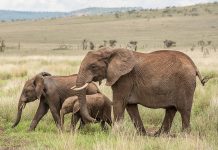
Across the continent, elephant and rhino poaching has increased sharply due to demand for ivory and rhino horn products. More than 20,000 African elephants are killed annually by poachers for their ivory, with rhino poaching steadily increasing.
“If we lose our elephants and other wildlife to this threat, it will not be because we lacked the knowledge or tools to save them, but because we all failed to take ownership of our wildlife heritage,” said Daudi Sumba, the Vice President of Program Design for AWF, at the launch of the campaign in the Kenyan capital, Nairobi. “None of us can afford to be bystanders when so much is at stake,” he said.
In a 2015 campaign survey of 2,000 Kenyans by WildAid, more than 96 per cent felt wildlife was important for national identity, heritage and the economy. Only 13 per cent said they didn’t care about wildlife, 21 per cent said it was a nuisance, and 28 per cent said poaching didn’t affect them.
“Clearly the vast majority of Kenyans strongly support conservation and understand its economic value. But our messages are designed to encourage a more active involvement in combating wildlife crime and we hope that this will extend greater protection to animals like pangolins and vultures that are not as charismatic as elephants and rhinos,”, said Peter Knights, WildAid CEO.
In recent years, the Kenya Wildlife Service (KWS) and its partners have done much to curb elephant poaching, such as deploying detection dogs to seaports and airports and strengthening the country’s wildlife laws and penalties. Numbers of poached elephants fell from 384 in 2012 to 93 in 2015.
Kitili Mbathi, the Director General of KWS, said Saturday’s burning of ivory was intended to ensure that the ivory did not reach the international market. “Without the demand there would be no poaching,” he said.