






Kenya is taking a bold stand against wildlife crime through improved enforcement action, higher penalties for wildlife criminals and last year it was the only African range State to report a significant fall in the number of rhinos poached, according to a new report unveiled today by TRAFFIC, a non-governmental organization working globally on trade in wild animals and plants, and the Kenya Wildlife Service (KWS)
Nevertheless, the country is highlighted as a key source and transit point for wildlife commodities exiting Africa, while the firm actions taken to stem wildlife crime are at risk of being undermined by weaknesses in laws governing wildlife trafficking, corruption, weak capacity and high demand in Asian markets.
“TRAFFIC’s report highlights the considerable progress made by the authorities in addressing wildlife poaching and trafficking in Kenya, but does not shy away from acknowledging the considerable challenges that lie ahead: it is a blueprint for taking action against the organized criminal syndicates who undermine our society and rob us of our wildlife,” said Richard Leakey, KWS chairman.
Among other findings, the USAID-funded report singles out the Mombasa port and Jomo Kenyatta International Airport in Nairobi as important exit points from Africa for illegally traded wildlife products from other countries, including Tanzania, Mozambique, the Democratic Republic of the Congo, Uganda, Zambia and South Sudan.
Since 2009, more ivory has been shipped through Mombasa than any other trade route out of Africa.
“Corruption among government and private sector officials is a key enabling factor of the illegal wildlife trade,” the report says.
“The fact that wildlife contraband, especially rhino horn and elephant ivory, has been exported from Kenya only to be seized in transit or in destination countries means that wildlife traffickers are able to exploit security loopholes in the country’s law enforcement network.”
The lack of regional and international co-operation in East Africa to address wildlife crime is also identified as a critical weakness, hindering efforts that would enable more emphasis to be placed on intelligence-based operations, making them more effective in targeting criminals higher up the trade chain.
“Future enforcement interventions in Kenya and elsewhere in the region need to be internationally co-ordinated and focus on targeting the middlemen and kingpins of large-scale trafficking, rather than easily replaceable low-level poachers and transport mules,” said Steven Broad, Executive Director of TRAFFIC.
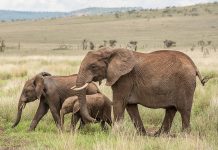
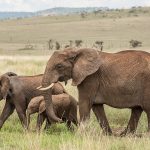
According to the report, after years of recovery, Kenya’s elephant population is undergoing a marginal decline, with around 32,500 animals left in the wild — still well below the estimated population of 167,000 in 1973.
Similarly, since 1970, Kenya’s rhinoceros population has fallen from around 20,000 to just 650 Black and 381 White Rhinos in 2014, although this is still the third largest rhino population in Africa after South Africa and Namibia.
In recent years, despite the valiant efforts of KWS and others, increasingly sophisticated poaching networks linked to organized crime have emerged, posing ever greater challenges to the security of wildlife and the people that manage and protect it. Corrupt security agents, porous borders, and endemic conflict among communities in northern Kenya facilitate the illicit flow of weapons used by local poachers.
Recent landmark rulings signal a clear departure from Kenya’s poor sentencing record: in January 2014, a Chinese ivory smuggler arrested in transit from Mozambique through Kenya with 3.4 kg of raw ivory received the minimum fine of 20 million Kenyan shillings ($200,000), while in May 2015 a magistrate in a rural town gave a woman found guilty of possessing five pieces of elephant tusks the choice of 40 million shilling ($412,056) fine or a four-year jail term.
Nevertheless, despite such rulings and legislative improvements, prosecuting wildlife crime in Kenya is still greatly hampered by an inadequate number of wildlife crime prosecutors as well as unclear laws, says the report. The inclusion of high minimum penalties has resulted in an increase in “not guilty” pleas and a consequent rise in the number of trials in a system already suffering from a significant backlog of cases.
The report concludes that Kenya needs to mobilize human and financial resources to prevent the illegal killing of wildlife in addition to partnering with conservation NGOs, relevant international bodies and diplomatic missions in a targeted and continuous dialogue, aiming to reduce the appetites of wildlife consumers, particularly in Asia.
Since the majority of Kenya’s wildlife lives outside formal protected areas, incentives for community-led conservation are also critical to the future of the nation’s natural heritage, the report notes.
The full report is available at: here