






NAIROBI, Oct 23 (Swara) – African elephants are evolving towards becoming tuskless in one of the regions where they were heavily poached for ivory during armed conflict, according to the findings of a new study published in Science journal.
The research was carried out in Mozambique where civil war from 1977 to 1992 saw 90 per cent of the country’s elephants decimated as armed groups slaughtered the pachyderms for ivory to finance the conflict.
“In response to heavy poaching by armed forces, African elephant populations in Gorongosa National Park declined by 90%. As the population recovered after the war, a relatively large proportion of females were born tuskless. Further exploration revealed this trait to be sex-linked and related to specific genes that generated a tuskless phenotype more likely to survive in the face of poaching,” the researchers, Campbell-Staton et al, write in their paper.
According to the study, the selective killing of species that bear anatomical features such as tusks and horns is the basis of a multibillion-dollar illicit wildlife trade that poses an immediate threat to the survival of ecologically important megafauna worldwide.
Megaherbivores are especially vulnerable to overharvesting because of their large habitat requirements, small population sizes, and long generation times. As ecosystem engineers, these species also behaviorally regulate ecological processes; anthropogenic selection on phenotypes that influence these behaviours may, therefore, have cascading effects on ecosystem functioning.
However, most work that details human-driven selection has focused on smaller species in which evolutionary change is more readily studied. It remains unclear to what extent, at what rates, and through what mechanisms harvest-induced phenotypic change occurs in the world’s largest land animals, the paper notes.
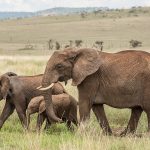
Before the war in Mozambique, about 18.5 per cent of females were naturally tuskless, a trait that made them undesirable to poachers. Among the 91 female elephants that have been born since the war, the researchers show, that fraction has risen to 33 per cent.
Mathematical modelling by evolutionary biologist Shane Campbell-Staton at Princeton University and his colleagues has confirmed that this shift is the result of hunting pressure — the selective killing of elephants with tusks has led to the birth of more tuskless offspring.
For the elephants, selection for tuskless females could have other knock-on effects. By looking at DNA in elephant faeces, the researchers learnt that tusked and tuskless animals eat different plants. “Because elephants are keystone species, changes in their diet can change the whole landscape,” notes study co-author Robert Pringle, a biologist at Princeton. And because the tuskless trait is fatal to male offspring, it is likely that fewer elephants will be born overall, which could slow population recovery even though poaching has now been stopped in the park. “Tusklessness might be advantageous during a war,” says Pringle, “but that comes at a cost.”