





On Friday, a Mombasa law court sentenced Feisal Mohamed Ali to 20 years in jail after finding him guilty of illegal possession of ivory worth 44 million shillings ( $440,000). The court also imposed a fine of 20 million shillings.
This landmark ruling by the Kenyan court is the end of a long story that began with the seizure of 2 tonnes of ivory at Fuji Motors car yard in Mombasa in June 2014.
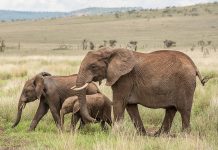
After more than 2 years of uncertainty and high drama, this exemplary sentence is justice for elephants.
The guilty verdict is a strong message to all networks of poaching gangs, ivory smugglers, financiers, middlemen and shippers that Kenya will not watch as its elephant population is decimated or its territory used as a conduit for traffickers.
Feisal Mohamed Ali is a well-known member of the business community in Mombasa. A warrant for his arrest was issued soon after the seizure of the ivory in Mombasa, but he was able to evade capture. Exactly how this happened has never been adequately explained.
Although the warrant for his arrest had been issued, civil society organisations voiced their concern about the lack of effort being made to track him down. On 12 August, on behalf of my NGO WildlifeDirect, I presented a letter signed by 400 Kenyans to David Kimaiyo, the then Inspector General of Police, urging him to make good the arrest warrant.
The turning point came in October when, following a landmark request by the Kenyan Government, Interpol issued a Red Notice identifying Feisal Mohamed Ali as one of the world’s most wanted environmental crime fugitives. WildlifeDirect publicised the arrest warrant by running a full page ‘Wanted’ advert in several newspapers.
Feisal was arrested in Tanzania on Christmas Eve 2014 and returned to Mombasa to face trial.
The trial itself was dogged by irregularities. The major evidence in the case, 9 motor vehicles that were under police custody, allegedly “disappeared” and a ruling on the inquiry as to the evidence tampering is yet to be delivered.
At one point, the magistrate handling the case granted Feisal Mohamed bond, overturning a previous high court ruling. A few weeks later, a new magistrate was assigned to the case. She opted to restart proceedings, but within days, the scene of crime, the Fuji Motors building in Mombasa, was demolished.
Throughout the court proceedings WildlifeDirect has held a watching brief on behalf of civil society, communities in Kenya that derive their livelihoods from wildlife — and elephants. Legal interns have acted as courtroom monitors, ensuring that the public is kept up-to-date on progress in the case and alerted when irregularities occur.
Kenya’s massive ivory burn at the end of April received huge global publicity, as a powerful statement of intent. The message was simple: Kenya will never condone or benefit from the slaughter of elephants for their tusks.
But this grand statement would be meaningless if it was not accompanied by concrete policing measures to protect elephants in the wild and apprehend poachers and traffickers. And arrests are meaningless unless those arrested are properly tried and, if convicted, punished.
It is often assumed that courts throughout Africa are both inefficient and corrupt. But calls to improve the situation carry little weight if they are based on anecdotal evidence. In 2013, WildlifeDirect published its first Courtroom Monitoring Report, providing concrete evidence of systemic failings in the prosecution of wildlife crimes.
Our second report, published this year, shows an improving situation. Case management has improved, conviction rates in contested trials have increased and penalties for those convicted have got tougher.
But our report found the system was mostly effective against low-level criminals. The kingpins — the high level traffickers who control the ivory trade — were still evading justice. We concluded: no high level trafficker has yet been convicted and sentenced by Kenyan courts.
The Feisal case is hugely significant because it means that another key element in Kenya’s joined-up strategy to defeat wildlife crime is in place. It fixes a hole in the net that is being drawn around poachers and traffickers.
This is not quite the end of the story as Feisal’s lawyers will be appealing against the conviction and sentence and prosecution will appeal against the acquittal of his five co-defendants.
But the conviction itself is a huge milestone and conservationists can breathe a sigh of relief. Acquittal in this case would have been a catastrophe. To Kenyans in wider society, increasingly concerned about corruption, the outcome of the case sends a positive message that justice can be achieved, with a lot of work and focused attention.
[This article was first published in The Guardian]
By Paula Kahumbu